
Another batch of lectures and I’m still not sure if I can do this. One reason for this could be that I am extrinsically motivated (Ryan, Frederick, Lepes, Rubio & Sheldon, 1997). In other words, I don’t run because I love it, I run because of a reward at the end of it. The act of running in itself is not rewarding for me but the consequences of running are for example, treating myself to chocolate milkshakes and sweet treats. Being extrinsically motivated can be effective for example, getting a paycheck from your job. However, the more often a person is extrinsically motivated the more likely it will lead to the overjustification effect. The more a person is extrinsically rewarded for an action such as running, the less likely they will be intrinsically (engaging in an activity because you like it) motivated to engage in those activities later (Lepper, Greene & Nisbett, 1973). This can make it difficult to go engage in activities such as running, later.
Being extrinsically motivated worried me as I thought I would never get into running and would become a failure before even really starting. However, all hope was not lost when the lecturer said it is possible to learn to be passionate and become intrinsically motivated. This is because experiencing effort and reward at the same time, can lead to the effort actually becoming rewarding. To become intrinsically motivated, I would have to go through the self-determination continuum, as shown below (Ryan & Deci, 2000). As the lecture began, it was clear to me I was externally motivated. I only engage in running for rewards that can be separate from running altogether. Over the following the 2 weeks I have managed to move up the continuum. As the weeks have been ticking down, my training plan is starting to become a habit which I feel the need to stick to. This means that I have been able to move on to the introjected stage as my brain thinks that I need to and should be going on these runs. At this point I am no longer engaging in runs just to get a reward; I am doing them because I feel the need to. If I think of missing a run then I begin to feel guilty which makes me more inclined to go on a run. By going on a run, I am protecting my ego from any negative feelings.
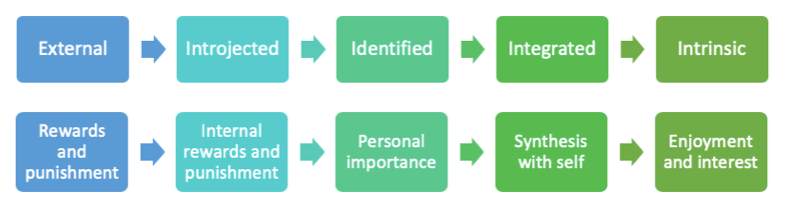
Currently I think I am at the identified stage. This is because I now realise the importance and relevance of running if I want to complete the marathon. To complete the module and marathon, I have got to engage in running. After a couple of bad training sessions and wanting to give up, I realised that I’m not going to be able to go any further without training and practising. I gave myself a purpose which was to prove the people who said I couldn’t run this marathon wrong. Training for the marathon is a must and is an important factor if I want to complete this marathon. At this stage, running is not necessarily enjoyable but is important for my growth towards the marathon. I am more self-determined at this stage due to it being more personal.
Aside from being extrinsically motivated, I think I have also struggled due to not taking control over my goals. I set myself the goal of the marathon and expected everything to just fall into place and for all the work to be done for me. How wrong I was. Over the past couple of weeks, it became clear that I needed to take control of my goal of running this marathon. To do that I have been introducing SMART goals (Lawlor, 2012) to my training plan.
Specific
When making goals, the aim needs to be specific. Goals must specify who is involved, where it occurs and why you are doing it in the first place. For example, my goal on a track day involves jogging down to Treborth running track on a Tuesday to complete drills with a friend. This goal is specific which allows me to focus on the goal for the session

Measurable
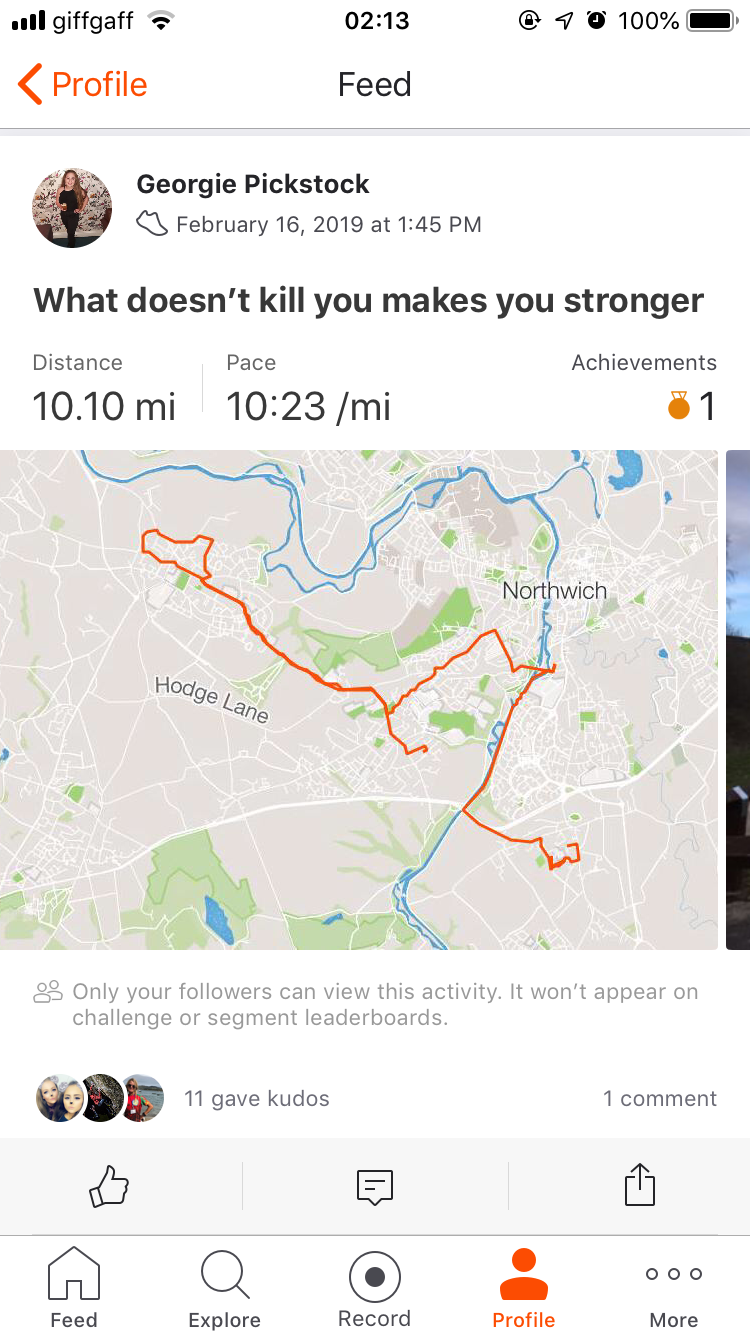
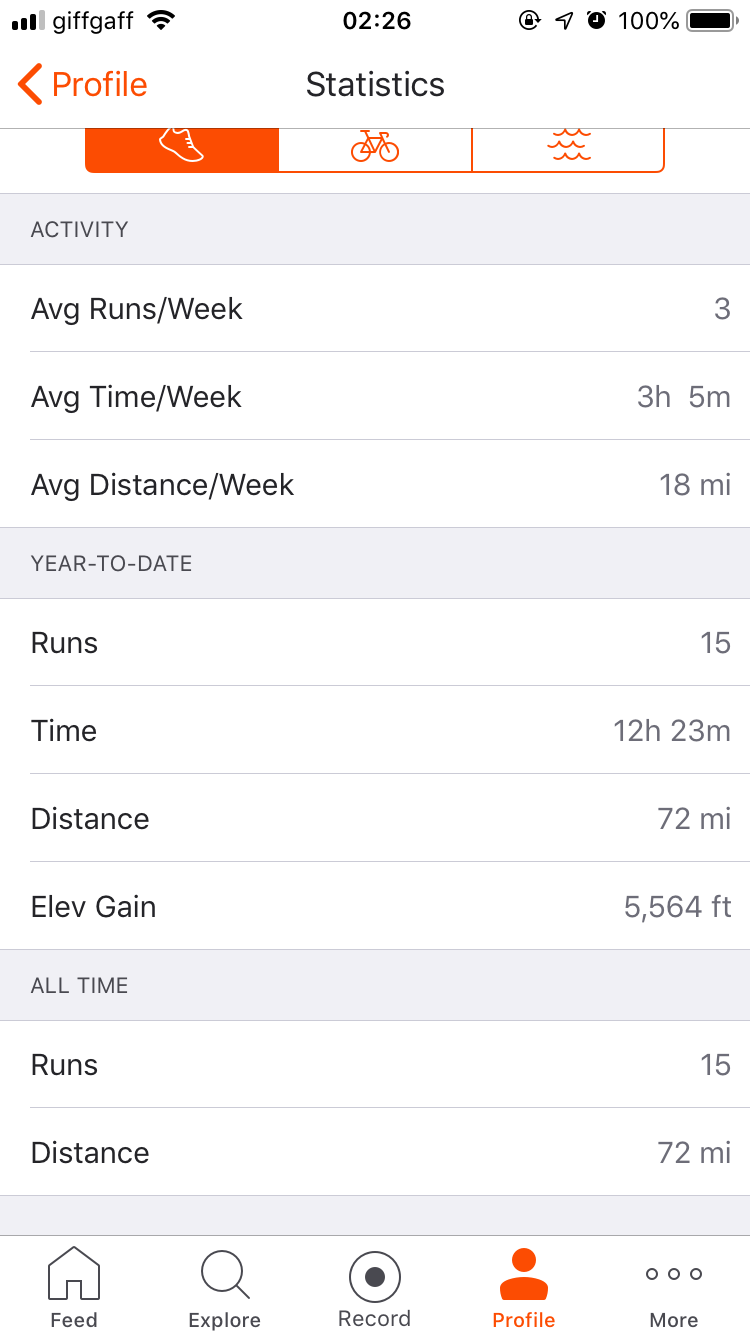
The goals made must be measurable so progress can be tracked. This helps to stay motivated as you can see how far you have come. For example, I track all my runs on Strava which allows me to keep track of my distances and speeds. This allows me to keep track of my progress and see how far I have come, which helps to keep me motivated.
Attainable
The goal set has to achievable in order for it to be a success. The goal needs to remain in reach of your capabilities but not below your standard performance. For example, with a training plan I should be able to complete the Liverpool marathon. There is enough time to train for the marathon so therefore, it should be achievable.
Relevant
Relevance refers to the goal having value or being relevant to your needs or other goals. The goal engaging in has to be worthwhile for it to be completed. For example, all the runs I complete before the marathon are relevant as they will help prepare me for the real thing. They allow me to build up my fitness so that I can run the 26.2 miles.
Timely
Goals must have a time limit as it helps prompt time management and ensures whether the goal is met or not. It also allows for a specific date to work towards. For example, the Liverpool marathon is on 26th May which has given me 18 weeks to begin training for it. This time limit has given me a date to work towards as well as time to build up my fitness.
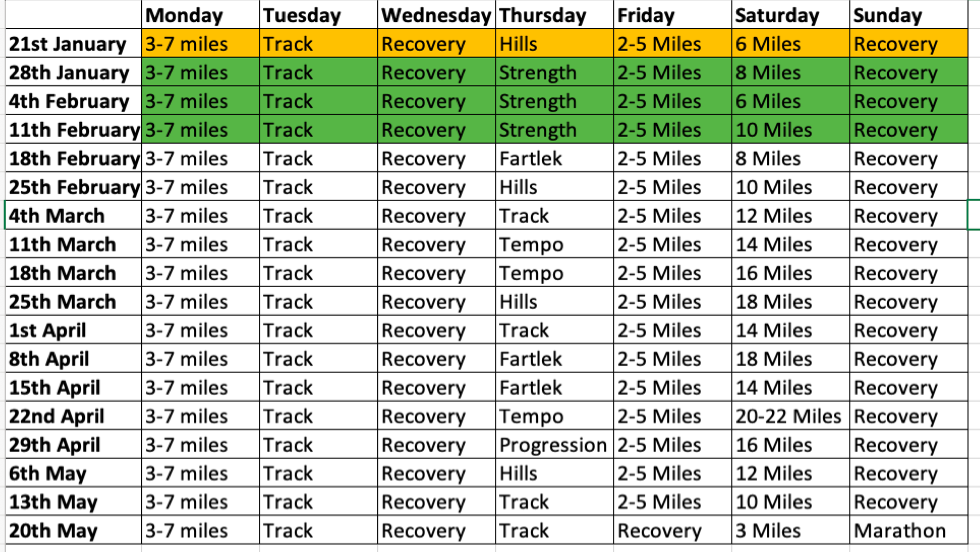
I have incorporated SMART goals in my training plan as it has been successful in multiple studies (Bovend’Eerdt, Botell & Wade, 2009; Johnson, Moore & Thornton, 2014). I have done this by breaking down each day of the training plan on flash cards. Each day has a goal that needs to be completed in order to train for the marathon. As shown in my training plan I have track every Tuesday, each track day has a different goal that I need to complete. For example, last Tuesday I had to complete 25x200m sprints whereas, next Tuesday I have to complete 7x800m runs which alternate between slow and fast pace. Knowing exactly what I’ve got to do each day of each week allows me to keep track of my progress and see how much I have accomplished. Each goal completed acts like a small win which keeps me motivated to continue training. As I complete each goal I mark it green so I can keep track of what I’ve done and be proud of what I have achieved so far.
This last two weeks of lectures has taught me a lot about myself and how to plan my life by setting goals. Being aware of how I am motivated has helped me understand more about the way I think and how I can change that. I have reflected a lot more on my running and progress which has changed my thinking slightly. I have come quite far in my training in such a short space of time and I take great pride in that. It is making me think about the importance of running for the marathon but also in staying healthy which is making going on runs easier. Furthermore, goal setting has allowed me to break down a big scary goal into little achievable ones. Having each session focus on something different keeps the training interesting and allows me to get the best out of it. Every sub-goal I achieve brings me one step closer to the marathon and makes me more confident. Suddenly the marathon isn’t so scary anymore.
References
Bovend’Eerdt, T. J., Botell, R. E., & Wade, D. T. (2009). Writing SMART rehabilitation goals and achieving goal attainment scaling: a practical guide. Clinical rehabilitation, 23(4), 352-361.
Eisenberger, R. (1992). Learned industriousness. Psychological review, 99(2), 248.
Johnson, C., Moore, E., & Thornton, M. (2014). A SMART Approach to Motivating Students in Secondary Physical Education: Editor: Ferman Konukman. Journal of Physical Education, Recreation and Dance, 85(4), 42-44.
Lawlor, K. B. (2012). Smart goals: How the application of smart goals can contribute to achievement of student learning outcomes. In Developments in Business Simulation and Experiential Learning: Proceedings of the Annual ABSEL conference (Vol. 39).
Lepper, M. R., Greene, D., & Nisbett, R. E. (1973). Undermining children’s intrinsic interest with extrinsic reward: A test of the” overjustification” hypothesis. Journal of Personality and social Psychology, 28(1), 129.
Ryan, R. M., & Deci, E. L. (2000). Self-determination theory and the facilitation of intrinsic motivation, social development, and well-being. American psychologist, 55(1), 68.
 Georgie's Running Blog