
The past couple of weeks have been disappointing and very tough. I’ve been off training due to tendonitis in my foot. Going from training 5 times a week to none was a big change and something that I really didn’t want to do. I was starting to enjoy running and training but now I’m worried that the lack of training will affect the marathon. I realised that the lack of belief in myself at this point in my training could be detrimental. This was touched upon in our lectures regarding negative self-talk.
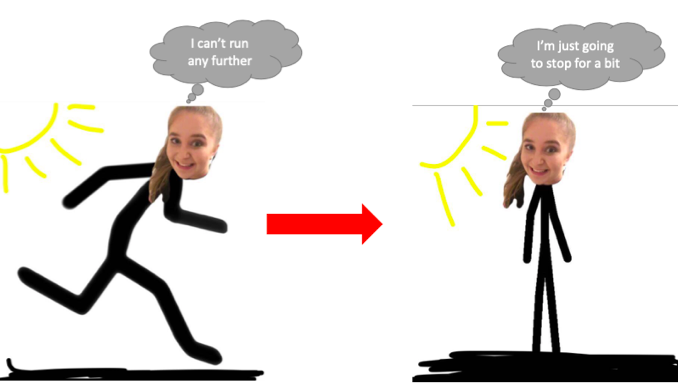
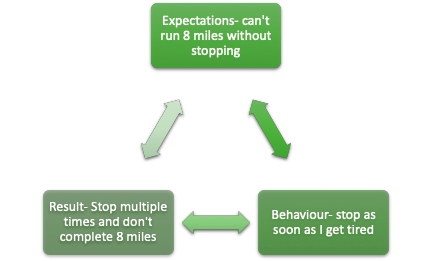
Negative self-talk is thinking or talking to yourself in a negative way which can lead to a loss in performance. Negative self-talk is said to be idiosyncratic which means that it can be motivating for some people but demotivating for others (Hardy, 2006). Unfortunately, I find it very demotivating and so it’s a problem for me when I go running. When I get tired or don’t feel like running, I will always say to myself “I can’t do this” or “I can’t run any longer”. Ultimately, this leads to me giving up and just walking for a bit or ending my run early. The negative self-talk reinforces ideas in my head that I can’t do something and so on runs I will stop. This stops me from performing and running at my full potential. It also hinders my training slightly because I don’t end up doing exactly what my plans tells me to do. For example, my training might say to do 10 hill sprints but I will only do 5 because “I can’t do anymore” even though I am more than capable of doing so. Using these negative phrases increases the amount of physical and cognitive anxiety which leads to things such as, irregular breathing and heart rate (Hatzigeorgiadis & Biddle, 2008). It also can lead to low self-esteem which would further affect performance. Negative self-talk can lead to a self-fulfilling prophecy, which means any expectations or beliefs that can affect behaviour causes situations to be created that fit those expectations (Weaver, Filson Moses & Snyder, 2016). For example, when I go on a run I expect to stop so I will stop more often even though I could probably run for longer. This can be a never-ending cycle and something I want to change.
Luckily positive self-talk is something that can be learned. Research by (Landin & Hebert, 1999) has shown that positive self-talk can increase motivation and performance, the outcome of the performance is irrelevant in terms of the effectiveness of positive self talk. I think it helps to maintain confidence after a setback and aids concentration. Both of these factors should help with performance even during a negative experience and stop it from being the worst possible experience. There are 2 kinds of positive self-talk: instructional snd motivational. Instructional self-talk, e.g. “keep shoulders down”, and motivational self-talk, e.g. “I can do this” have been shown to be equally effective in endurance sport such as, running (Theodorakis et al., 2000). Instructional self-talk focuses more on the skills of the activity which helps to maintain form and performance whereas, motivational helps to increase confidence (Hatzigeorgiadis, Zourbanos, Mpoumpaki & Theodorakis, 2009).
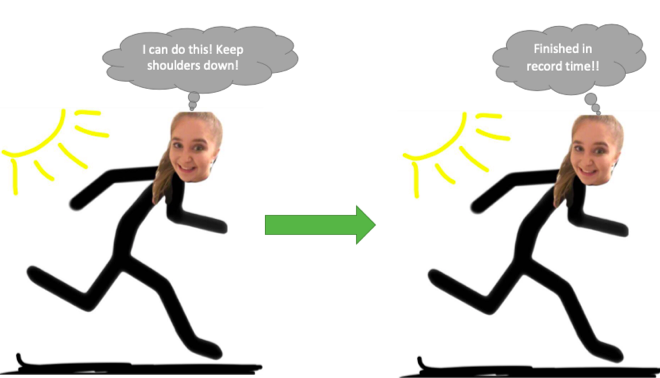
To change my self-talk to be more positive I have started to practice saying positive statements (Hamilton, Scott & MacDougall, 2007). This repetition helps to form a habit so that I don’t have to think about engaging in self-talk. The self-talk must be believable and achievable. For shorter distances below 13 miles, I know I can run without stopping so I can tell myself I can do this without stopping. This is believable because I’ve already done it. For longer distances, I will break it down into goals. So when running starts getting more difficult, I can say “keep running for the next half a mile” and if I achieve that I’m more likely to want to continue. This is because completing small goals will break up the run and build my confidence. It will also redirect my attention to running when I’m feeling tired. By concentrating more, I can make sure my running form is correct to help prevent injury. Overall, this self-talk will be more beneficial to my running by building my confidence and aiding by concentration to improve or maintain my performance, as well as preventing injury.
Positive self-talk also helps a lot in building resilience, something I am also trying to learn. Resilience is basically bouncing back from adversity and setbacks which is something I am currently trying to do. There are many theories about resiliency and most of them are quite similar. However, Fletcher and Sarkar’s (2012) and Denz-Penhey and Murdoch’s (2008) theories cover the main aspects of resiliency that I think are crucial. Fletcher and Sarkar’s theory of psychological resilience and optimal sports performance emphasises the need for positivity, motivation, confidence, focus and perceived social support. All these factors help a person to become resilient. However, Denz-Penhey and Murdoch’s theory of personal resilience contains the factor experiential inner wisdom which I think is also important for resilience. I think experiences are important to be resilient because you can learn from them and use them in the future. But they also make you stronger. I believe combining aspects of both theories will help me develop my resiliency when I get future setbacks. I created a plan of action for each aspect to help me get over my current injury as well as future problems.
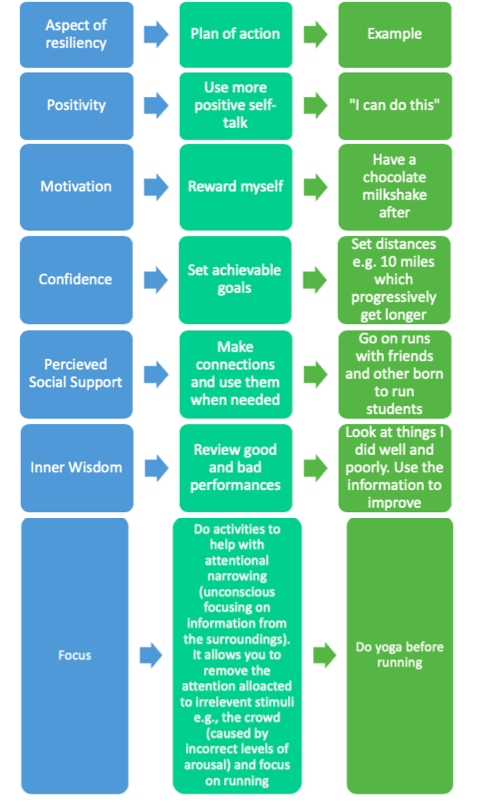
Strengthening these areas will allow me to bounce back from setbacks more quickly and effectively. I began training again the other day and I am already finding these aspects useful. Being positive is harder than I thought. I really didn’t realise how much of a depressing person I am. I need more practise with positive self-talk however, I am a lot more positive than I was before I recognised my negative self-talk tendencies. I feel a lot more prepared for anything that comes my way now. Hopefully I might just make it to the marathon and complete it.
References
Denz-Penhey, H., & Murdoch, C. (2008). Personal resiliency: Serious diagnosis and prognosis with unexpected quality outcomes. Qualitative Health Research, 18(3), 391-404.
Fletcher, D., & Sarkar, M. (2012). A grounded theory of psychological resilience in Olympic champions. Psychology of sport and exercise, 13(5), 669-678.
Hamilton, R. A., Scott, D., & MacDougall, M. P. (2007). Assessing the effectiveness of self-talk interventions on endurance performance. Journal of Applied Sport Psychology, 19(2), 226-239.
Hardy, J. (2006). Speaking clearly: A critical review of the self-talk literature. Psychology of Sport and Exercise, 7(1), 81-97.
Hatzigeorgiadis, A., & Biddle, S. J. (2008). Negative Self-Talk During Sport Performance: Relationships with Pre-Competition Anxiety and Goal-Performance Discrepancies. Journal of Sport Behavior, 31(3).
Hatzigeorgiadis, A., Zourbanos, N., Mpoumpaki, S., & Theodorakis, Y. (2009). Mechanisms underlying the self-talk–performance relationship: The effects of motivational self-talk on self-confidence and anxiety. Psychology of Sport and exercise, 10(1), 186-192.
Landin, D., & Hebert, E. P. (1999). The influence of self-talk on the performance of skilled female tennis players. Journal of applied sport psychology, 11(2), 263-282.
Theodorakis, Y., Weinberg, R., Natsis, P., Douma, I., & Kazakas, P. (2000). The effects of motivational versus instructional self-talk on improving motor performance. The sport psychologist, 14(3), 253-271.
Weaver, J., Filson Moses, J., & Snyder, M. (2016). Self-fulfilling prophecies in ability settings. The Journal of social psychology, 156(2), 179-189.
 Georgie's Running Blog