
After 11 weeks at University this semester Easter break is finally here and I have never wanted it so much. It has been a busy semester in this final year and I had definitely been craving this break. But unfortunately, that means being away from everyone that has so far been helping me on my marathon journey. This means this Easter break is going to be the most challenging because with longer runs coming up, the temptation to deviate from my training plan will get stronger.
The Zone of Proximal Development is the distance between a learner being able to problem solve on their own compared to when their ability at problem-solving with support from a more capable peer (Vygotsky, 1978). It allows me to understand and come to my full potential and develop into the best runner I can be. Staying in the middle zone means that I don’t get frustrated if things are too hard or easy for example, running 5k is easy for me but 20 miles can be challenging. I would get bored of completing 5 k’s all the time as this is my comfort zone, but could not run 20 miles on my own at all. To be able to move through my zone of proximal development I need to be supported by a skilful tutor or more capable peers in order to develop (Shabani, Khatib & Ebadi, 2010). During the semester, I have done this as I’ve been able to run further and bounce back from injury with the help of the born to run group. Others in the group have been injured and have been able to support me and offer advice as what to do (making them more knowledgable). This has enabled me to continue running and improve it over the course of the semester. A lot of learning happens by looking at model behaviours which happen during our running class on a Tuesday. These model behaviours are meant as a guide and enable me to regulate my own performance. It is also important to have scaffolding and have supported activities for the learner. In my case, my training plan offers me a routine and structure to help me maintain my training.
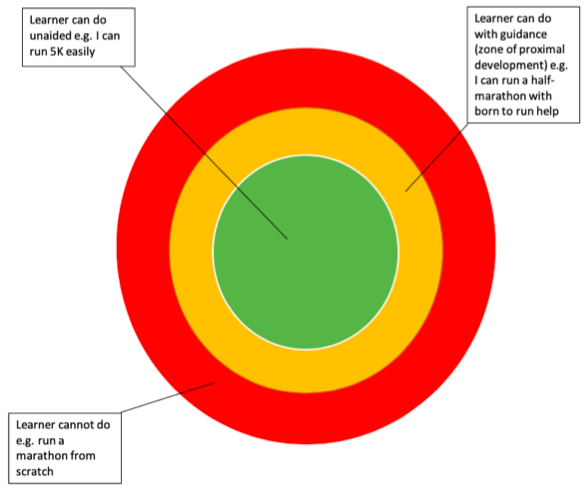
Scaffolding is a process that enables a learner to achieve a goal that they wouldn’t be able to do on their own (Wood, Bruner & Ross, 1976). The born to run group offers me that scaffolding as I don’t think I’d be able to complete the marathon without the group. Scaffolding needs a tutor to control the task and elements that are beyond the learners initial learning as it allows the learner to concentrate on the elements within their zone and allow them to grow (Verenikina, 2003).
The lecturers have provided support and guided us through this marathon journey and pointed us the right direction when needed. The born to run group allows for peer learning which is also really useful (Shooshtari & Mir, 2014). This is because learners can stretch their boundaries with a more knowledgeable peer and peers can consolidate their learning (Prichard, 2013). Other people in the born to run group can help me achieve goals by pushing me to reach my goals and offering me advice on things that have worked for them.
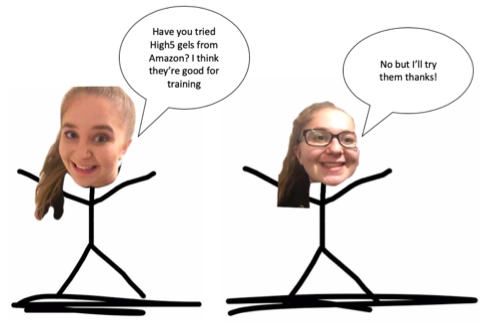
Scaffolding is normally tapered off as it becomes unnecessary for the learner which allows the learner to gain skills for later problem solving on their own. I feel this is currently occurring in the born to run group as we break up at Easter. I am going to have to deal with my training and any problems alone over Easter, however hopefully I have developed enough skills to deal with this.
To make sure I stay in the right zone and maintain some form of support over Easter, I need to compete with myself. There is no point competing with other people if they are much quicker than me. I might as well compete against myself which helps me go quicker as it is in my Zone of Proximal Development. I also need to communicate with other people in the born to run group for support and in case I encounter any difficulties. This support offers a support network over Easter that makes me accountable for the runs and activities I involve myself in. Group support has been shown to be really effective by Harvey-Berino, Pintauro, Buzzell and Gold (2014) with people trying to lose weight. This is because people become accountable for their actions and the peer pressure makes them more likely to stay on track. This study has shown that this group support works over the internet and so I am hoping this will work for me over Easter with the born to run group.

Overall, Vygotsky’s Zone of Proximal Development has helped me understand my capabilities and improve my performance over the semester. However, I think it should be used with Piaget’s theory of cognitive development as that has key concepts that also apply to me and is based more on independent learning (Huitt & Hummel, 2003). For example, development is driven by adapting to new experiences rather than social interactions and experiences. This concept is important as it can help develop skills such as grit, which is extremely handy for marathons! By applying both theories I can develop my running to the best standard possible.
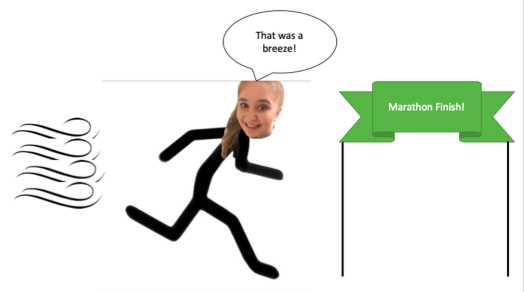
This week has given me new experiences which I would not have dared to have attempt however, they have taught me I can do anything I have set my mind to. As long as I have the right support and scaffolding I can achieve almost anything I want to. Over Easter as long as I stay accountable, I should stick to my training plan and I will breeze through this marathon. Or at least that’s the hope.
References
Harvey‐Berino, J., Pintauro, S., Buzzell, P., & Gold, E. C. (2004). Effect of internet support on the long‐term maintenance of weight loss. Obesity research, 12(2), 320-329.
Huitt, W., & Hummel, J. (2003). Piaget’s theory of cognitive development. Educational psychology interactive, 3(2), 1-5.
Prichard, D. (2013). ‘Strategies, methods and techniques used by coaches to ensure their athletes remain in the Zone of Proximal Development (ZPD), to ensure maximum learning and skill development occurs’.
Shabani, K., Khatib, M., & Ebadi, S. (2010). Vygotsky’s Zone of Proximal Development: Instructional Implications and Teachers’ Professional Development. English language teaching, 3(4), 237-248.
Shooshtari, Z. G., & Mir, F. (2014). ZPD, tutor; peer scaffolding: Sociocultural theory in writing strategies application. Procedia-Social and Behavioral Sciences, 98, 1771-1776.
Vygotsky, L. S. (1978). Mind in Society. Cambridge, MA: Harvard University Press. Retrieved from: http://www.proactiveteaching.org/pdfs/91.pdf
Wood, D., Bruner, J. S., & Ross, G. (1976). The Role of Tutoring in Problem Solving. Journal of child psychology and psychiatry, 17(2), 89-100. doi: 10.1111/j.1469-7610.1976.tb00381.x
 Georgie's Running Blog